



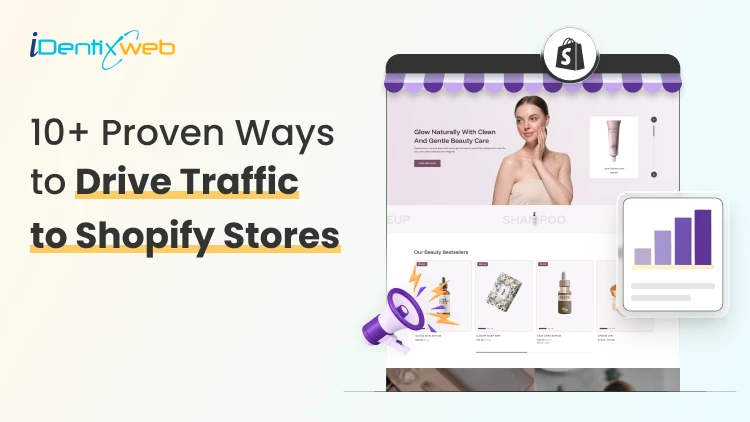

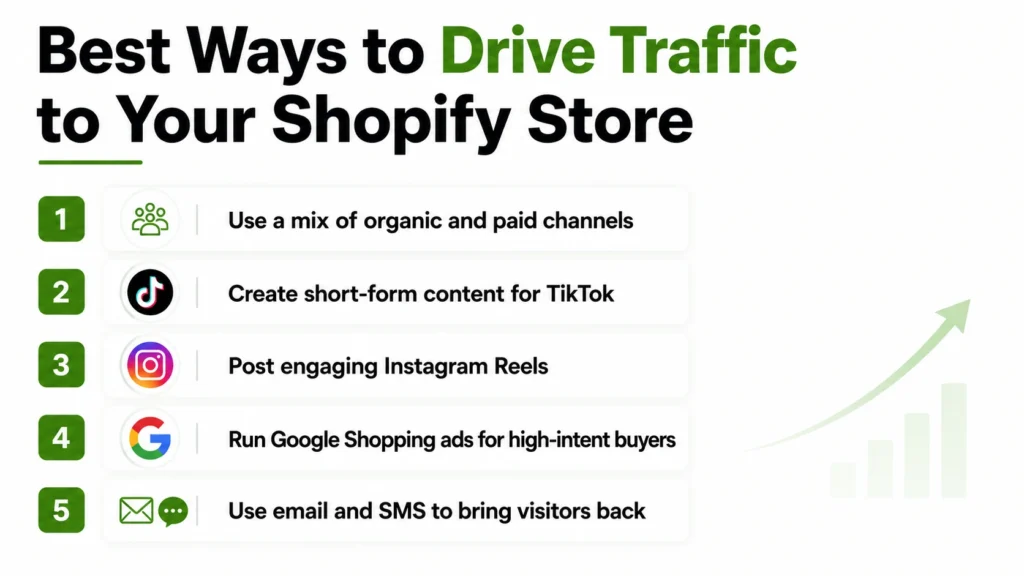
To increase traffic to your Shopify store, use a balanced mix of organic, paid channels. Create short-form content for TikTok and Instagram Reels, run Google Shopping ads to reach high-intent buyers, and use email and SMS marketing to bring visitors back to your store.
Launching a Shopify store is the easy part in 2026 with all the AI solutions. Getting people to actually find it now is where merchants are struggling.
The good news: You don't need a massive ad budget to get more traffic to a Shopify store.
A mix of optimizing product pages for AEO and SEO, referrals, email, and influencer outreach done consistently is what drives traffic for stores.
Here's how to increase Shopify traffic for every store in every tier that fits every stage of your growth.
How to Drive Traffic to Your Shopify Store?
1. Get your Shopify store optimized for SEO
SEO is still the highest-leverage traffic channel for a Shopify store, and it's not close. You are building something that keeps sending visitors long after you stop touching it.
The catch is that most merchants treat it as a launch-day checklist instead of an ongoing job. That's exactly why their traffic goes down after a few months.
Start with keyword research that actually reflects buyer language.
"Shoes" tells Google nothing about intent. "Women's waterproof hiking shoes size 8" tells it all. It converts at a much higher rate because the searcher already knows what they want. Work that keyword data into:
- Product titles and descriptions
- Collection page copy (150 to 200 words minimum above the product grid, or Google has nothing to rank)
- Image alt text
- Meta titles and meta descriptions
- Blog titles and headings
Shopify's default Dawn and Online Store 2.0 themes already ship basic Product, BreadcrumbList, and Organization schema, but they usually stop there. Article and FAQ schema always need manual work or an app, and skipping them costs you rich snippet eligibility that your competitors are already capturing.
2. Optimize for AI search (AEO)
I'd prioritize AEO right after basic SEO is handled.
A meaningful share of product research now happens inside ChatGPT, Perplexity, and Google's AI Overviews instead of a traditional results page.
If your store isn't structured for those systems to read, you're invisible to that traffic no matter how good your product is.
AI shopping tools read your structured data before they read your page's HTML. When ChatGPT Shopping or an AI Overview decides what to recommend, it parses your Product schema for details like name, price, availability, brand, and rating. If that data isn't there, the LLMs won’t pick it up.
Shopify’s own insight says that AI-referred shoppers convert at a 49% higher rate than organic.
Two things I always do:
- Fill out the complete Product schema like name, price, availability, brand, description, and image.
- Build out the FAQPage schema on product and category pages. FAQ blocks with proper markup are the format AI systems cite most often because the question-answer structure matches exactly how these tools retrieve information.
3. Drive traffic to your Shopify store with content marketing
Content brings in the shoppers who aren't ready to buy today but are actively comparing options.
For example, a simple gift guide or comparison post can rank for years and boost your store traffic. One solid post a week, published consistently, beats five posts one month and nothing for the next three.
4. Keep a referral program running
A referral program turns customers you already have into a traffic source.
Referred visitors convert better too, since they're showing up on a friend's word instead of an ad they've learned to ignore.
Keep the structure simple: give a discount, get a discount. Anything more complicated, and customers won't bother explaining it to a friend.
The timing matters too. Put the offer in front of people right after checkout, in the order confirmation email, and on the account dashboard, since those are the moments they're actually thinking about your brand.
5. Use email marketing to bring visitors back
Email doesn't compete for attention the way social or paid attention does. People check it on their own time, which makes it one of the most reliable ways to pull past visitors back to your store.
The mistake I see constantly is that merchants send one welcome email at launch and then don’t send any emails at all.
I heavily use these 5 types of emails to redirect visitors to stores.
- Welcome series: Introduces the brand, sets expectations, and gives new subscribers a reason to buy now instead of later.
- Abandoned cart: The single highest-converting email most stores will ever send.
- Browse abandonment: Catches people who looked at a product page but never added it to cart.
- Post-purchase cross-sell: The easiest incremental revenue you'll ever capture, sent to people who already trust you enough to buy once.
- Win-back: Triggered after 60 to 90 days of no purchase or engagement, before the customer forgets you exist.
Segment by what someone bought or how much they've spent. Blasting your entire list with the same message every time is the fastest way to tank your open rates and waste the list you worked to build.
6. Get into influencer marketing
Influencer marketing works because it borrows trust you'd otherwise spend months earning.
It only pays off if you pick the right person. An account with millions of followers still won’t get you traffic if the influencer is not in your domain.
Before you reach out to anyone:
- Check engagement rate, not follower count. A smaller account with a genuinely engaged audience will outperform a bigger one.
- Look at whether they've promoted anything similar before, and read how their audience actually reacted in the comments.
- Start small: one paid post or an affiliate arrangement before committing to anything bigger.
Almost half of the Shopify stores use Instagram to reach their audience. Followed by Facebook and TikTok. [Source: Store Leads]
7. Run paid ads where your customers already are
Organic channels take time to build momentum. If you need traffic immediately, paid ads are the shortcut.
Google Shopping tends to convert best because the shopper is already searching with intent to buy.
Meta and TikTok are better for reaching someone who fits your audience but isn't actively looking yet.
A few things that make paid spend actually worth it:
- Install tracking (Meta Pixel, Google Ads conversion tracking) before you spend a cent.
- Set a modest daily budget and give the algorithm 7 to 10 days before touching it. Ending a campaign early will affect the learning phase, and you never find out if it would've worked.
- Retarget the people who visited and left. Adding the Facebook Pixel to your Shopify store is the first step that makes retargeting possible at all.
For Shopify Plus stores, the channels don't change. You have the traffic volume to run multiple paid channels at once and actually get useful data back from each.
Meta and Google Shopping both scale well at Plus-level volume because you clear the algorithm's learning phase fast enough to iterate quickly.
8. Use SMS marketing for time-sensitive traffic
SMS works best when you need people to act now.
Emails can sit unread for days. Text messages usually get seen much faster, which makes SMS useful for flash sales, restocks, limited drops, delivery updates, and abandoned carts.
The mistake I see often is using the email channel and sending long promotional messages every few days.
I mainly use SMS for:
- Abandoned cart reminders: Send one short reminder with a direct link back to the cart.
- Back-in-stock alerts: These work well because the customer has already shown interest in the product.
- Limited-time offers: Use SMS when the deadline is real, not as a fake urgency tactic.
- Order and delivery updates: Transactional messages keep customers informed and reduce support questions.
- VIP access: Give repeat customers early access to product launches or sales.
9. Build a consistent social media marketing system
Social media can send steady traffic to your Shopify store, but only when the content gives people a reason to stop scrolling.
Posting product images every day is not a strategy. Customers also want to see how the product works, who it is for, what problem it solves, and why they should trust the brand.
I normally rotate between these content types:
- Product demonstrations: Show the product being used instead of only displaying it.
- Customer content: Reviews, unboxing videos, and customer photos build trust faster than polished brand posts.
- Educational posts: Answer common questions and help people make better buying decisions.
- Behind-the-scenes content: Show how products are made, packed, tested, or delivered.
- Offer-based posts: Promote launches, bundles, restocks, and limited discounts without making every post a sales pitch.
Pick one or two platforms where your customers already spend time and post consistently there.
To wrap it up
Shopify traffic cannot be increased by implementing just one strategy. The best strategy that worked for me is the SEO and AEO working together, and content that actually answers questions.
Pick one or two of these that fit where your store is right now, get them producing real numbers, then add the rest.
FAQ
1. How to drive traffic to a Shopify store?
Drive traffic by combining long-term channels such as SEO and content marketing with faster channels such as paid ads, social media, influencer partnerships, email, SMS and referral campaigns. Track sessions, conversion rates and sales by traffic source in Shopify Analytics so you can invest more in the channels that bring qualified visitors.
2. Can Shopify handle high traffic?
Yes. Shopify hosts stores on fast global servers, does not limit store bandwidth and uses Cloudflare’s content delivery network to manage traffic worldwide. However, an overloaded theme, unnecessary apps and excessive third-party scripts can still slow down the customer-facing store during busy periods.
3. How to convert traffic into sales in Shopify?
Improve your conversion rate with clear product information, strong images, reviews, transparent shipping details, relevant offers and a fast, simple checkout experience. Use Shopify’s conversion funnel reports to identify whether customers are leaving before adding to cart, reaching checkout or completing their purchase, then improve that specific stage.
4. How to get organic traffic into your Shopify store?
Target relevant search terms with clear buying intent and use them naturally across product pages, collection descriptions, page titles, meta descriptions, image alt text and blog content. Strengthen your SEO further with internal links, useful original content, structured data and quality backlinks from trustworthy websites in your niche.
5. What is direct traffic on Shopify?
Direct traffic refers to visitors who reach your Shopify store without a recorded referring channel, commonly by typing your store URL into their browser or using a saved bookmark. Campaign visits may also be difficult to attribute correctly when links are not tagged, so add consistent UTM parameters to email, social media and advertising links.

About the author
Sajini Annie John
Meet Sajini, a seasoned technical content writer with a passion for e-commerce and expertise in Shopify. She is committed to helping online businesses to thrive through the power of well-crafted content.